
t
Blog
-

Beyond the vCISO: Closing Security Gaps With TalentSplit’s Residency Model
TalentSplit’s residency model closes the “execution gap” a vCISO can’t cover alone. A vCISO identifies the gaps and sets priorities. TalentSplit closes those gaps through supervised project delivery using a vetted technical workforce of expert-supervised high schoolers and career-transitioning adults.
Most organizations do not fail because they lack guidance. They fail because the tactical work stalls. Tickets pile up. Evidence for audits stays incomplete. “We’ll get to it next quarter” becomes the plan. TalentSplit turns those backlogged security tasks into scoped projects with senior oversight, measurable deliverables, and work-based skills validation that supports proof-of-work hiring and helps you hire IT talent safely.
Why Strategic Oversight Isn’t Enough
The vCISO model has gained massive popularity because it provides executive-level security expertise at a fraction of the cost of a full-time hire. However, a common friction point emerges: the “Execution Gap.” A vCISO can draft a world-class Incident Response Plan or highlight the need for Multi-Factor Authentication (MFA) across all legacy systems, but they rarely have the bandwidth to perform the manual configuration, testing, and troubleshooting required to roll those initiatives out.
To close these gaps, organizations traditionally look to two options:
- General Staffing: Hiring contractors who may or may not have the specific skills required.
- Internal Reallocation: Pulling internal IT staff away from core business operations to handle security projects.
Neither of these effectively addresses the need for a vetted technical workforce. The missing component is a structured delivery model that combines leadership with “boots on the ground” execution.
Industry Benchmarks, Then Real Execution
A solid vCISO program is built on consistent expectations for what “good” looks like. In practice, many teams align to widely recognized CISO operating concepts: clear ownership, measurable controls, durable documentation, and an audit-ready rhythm of work. That leadership model is the “what” and the “why.”
TalentSplit exists to deliver the “how.”
We take vCISO priorities and convert them into supervised, ticket-ready execution. That means:
- Defined scope. Clear outcomes. Clear acceptance criteria.
- Resident delivery. Residents do the work.
- Expert oversight. Senior practitioners review, correct, and sign off.
- Evidence capture. Notes, screenshots, change logs, and runbooks are produced as part of delivery.
- Optional conversion. High performers can move into your team through a project-to-hire pipeline.
Why This Model Works (Without Adding Risk)
- Reduced management overhead: Your team is not babysitting. Supervision is built in.
- Supervised project delivery: You get consistent output and consistent documentation.
- Verified cybersecurity talent: Work is reviewed against professional standards before it is handed back.
- Proof-of-work hiring: You evaluate real deliverables, not interview performance.

Quantifying Readiness: Technical Proficiency Benchmarks (300–850)
One hiring problem shows up everywhere: “ready” is vague. Resumes are noisy. Certifications are incomplete. Interviews reward confident talkers.
TalentSplit uses technical proficiency benchmarks to keep readiness measurable. We commonly use a 300–850 scoring range (similar to a credit-score style model) to validate baseline capability before a resident is placed on client work.
- 300–500 (Foundational): Understands concepts. Needs tight supervision. Best for internal practice and low-risk tasks.
- 500–700 (Proficient): Executes standard tasks with review. Strong fit for supervised project delivery.
- 700–850 (Expert): Leads workstreams. Mentors others. Owns final review and escalation.
This is not a perfect system. Scores evolve. Real environments vary. That is why we pair benchmarking with work-based skills validation. The benchmark gets people in the right lane. The supervised project proves they can drive.
The TalentSplit Residency Model: vCISO Gaps In, Supervised Delivery Out
TalentSplit is not classic staff augmentation. It is a residency-based delivery system. Residents execute. Experts supervise. Clients receive finished work and audit-ready evidence.
1. Intake From Your vCISO (or Security Lead)
We start with the prioritized gaps already identified. Typical inputs:
- Vulnerability scan findings and remediation targets
- Policy and control gaps
- Audit evidence requests
- Backlogged security tickets
2. Scope Into a Deliverable-Driven Project
We turn “we should fix this” into a scope your team can approve:
- Clear start and finish
- Acceptance criteria
- Systems in scope
- Communication cadence
- Documentation requirements
3. Assign Residents Using Technical Proficiency Benchmarks
Residents are placed based on proficiency level and the risk profile of the work. Work is structured so residents can ship real outcomes while staying inside guardrails. This is how we build verified cybersecurity talent without gambling on unsupervised execution.
4. Supervised Execution With Senior Review
Residents do the hands-on work. Senior experts:
- review changes
- correct mistakes early
- validate results
- standardize documentation
This is the difference between “junior help” and a vetted technical workforce producing reliable outcomes.
5. Proof-of-Work Hiring Built In
Every deliverable is a live audition. You see:
- quality of execution
- documentation habits
- communication style
- how they respond to feedback
That is proof-of-work hiring in a controlled environment. It is also the safest path to hire IT talent safely.

Why Expert-Supervised High Schoolers and Career-Transitioners Help Solve the Talent Gap
The talent gap is real. The backlog is real. What is optional is taking unnecessary hiring risk.
TalentSplit’s model works because residents are not operating alone. They are delivering inside a supervised system that converts learning into production-grade output.
For organizations, this creates a reliable supply of verified cybersecurity talent without pretending every contributor is a senior engineer on day one. For residents, it creates real experience with feedback loops that make skills stick.
What this enables in practice:
- Work-based skills validation: competence is demonstrated through shipped work.
- Supervised project delivery: quality is enforced through expert review.
- Vetted technical workforce: residents mature into dependable operators through repetition and standards.
- Proof-of-work hiring: you can confidently extend offers based on observed performance, not guesses.
The Project-to-Hire Pipeline: Proof-of-Work Hiring, Not Leap-of-Faith Hiring
The project-to-hire pipeline is simple. We deliver the project. You keep the outcomes. If a resident is a great fit, you can hire them after you have real proof.
Why It Works
- Hire IT talent safely: You base decisions on delivered work in your environment.
- Verified cybersecurity talent: Performance is observed under supervision and standards.
- Lower ramp-up: If you hire, they already know your tools, tickets, and expectations.
- Less hiring regret: The “test drive” happens before the offer, not after.
Conclusion: vCISO Direction + Residency Execution
A vCISO is great at identifying risk, setting priorities, and defining what “done” means. Most organizations still struggle with the next step: getting the work finished.
TalentSplit closes that gap with a residency model built for execution:
- Supervised project delivery that produces real outcomes and real documentation
- A vetted technical workforce benchmarked for readiness (including a 300–850 proficiency range)
- Proof-of-work hiring through a project-to-hire pipeline so you can scale safely
If you need to clear the tactical work that clogs a CISO’s schedule, without gambling on unsupervised contractors, TalentSplit is built for that. Whether you are pushing toward cyber insurance readiness or cleaning up long-standing control gaps, we can help you move from recommendations to results.
Frequently Asked Questions
How does TalentSplit work alongside a vCISO?
Your vCISO identifies and prioritizes gaps. TalentSplit closes them through supervised project delivery. We take the backlog and turn it into scoped projects with senior review and audit-ready documentation.
What do you mean by “technical proficiency benchmarks”?
We use readiness benchmarks (including a 300–850 scoring range) to place residents appropriately before they touch client systems. Then we validate performance through work-based skills validation during delivery.
What kind of tactical wins can you deliver quickly?
Common early wins that unclog a CISO schedule include:
- vulnerability patching coordination and remediation support
- basic security audits and evidence collection
- policy and procedure documentation
- asset and access documentation clean-up
- control testing prep and remediation tracking
Can we hire the residents who do great work?
Yes. That is the point of the project-to-hire pipeline. It supports proof-of-work hiring so you can hire IT talent safely based on observed performance.
Is this just staff augmentation?
No. Staff augmentation hands you a person and makes you the manager. TalentSplit provides a supervised delivery system: residents execute, experts supervise, and you receive finished work from a vetted technical workforce.
-
7 Mistakes You’re Making with IT Staff Augmentation (and How Work-Based Skills Validation Fixes Them)
Traditional IT staff augmentation is often a gamble. You review a stack of resumes, conduct a few thirty-minute interviews, and hope the “Senior Developer” you just hired doesn’t turn out to be a junior in disguise. The industry average for mis-hires in technical roles is staggering, often leading to project delays, technical debt, and burned-out internal teams.
At TalentSplit, we’ve seen these patterns repeat across organizations of all sizes. The root cause is almost always a lack of work-based skills validation. When you hire based on a PDF instead of proven performance, you’re essentially guessing. Our residency model changes the equation by providing supervised talent: ranging from senior-guided high schoolers to career transitioners: who have already been validated through real-world technical tasks.
Here are the seven most common mistakes companies make with IT staff augmentation and how a skills-validation framework like ours fixes them.
1. Falling for “Paper Tigers” (Not Validating Technical Experience)
The most frequent mistake is assuming that a “Senior” title on a resume translates to competence in your specific environment. Many agencies promise high-level profiles but deliver staff who have the certifications but zero practical experience with complex, integrated systems.
The Fix: Live Validation & Senior Oversight
Work-based skills validation moves beyond the interview. It involves live technical assessments and code challenges that mirror your actual work environment. At TalentSplit, we take this further with our residency model. Our talent doesn’t just work in a vacuum; they are supervised by senior professionals. This ensures that every line of code or security configuration is checked against industry standards before it ever reaches your repository.2. Prioritizing Hourly Rate Over Total Capability
It’s tempting to choose the provider with the lowest hourly rate. However, the “cheap” developer often becomes the most expensive line item. Poor code quality, communication barriers, and high turnover rates can inflate project costs by 30% or more.
The Fix: Focusing on Value and ROI
Instead of looking at cost per hour, look at value per milestone. Skills validation ensures you are paying for actual expertise. Our model utilizes a mix of talent: including highly capable career transitioners: who provide high-quality technical services at a sustainable price point. Because they are part of a supervised residency, you get the benefit of senior-level oversight without the senior-level price tag on every single hour of labor.
3. Hiring for “Bums in Seats” Without Clear Objectives
Many companies rush into augmentation by asking for “three Java developers” without defining what success looks like. Without clear deliverables or a gap analysis, augmented staff often end up underutilized or working on the wrong priorities.
The Fix: Comprehensive Scoping and the Innovation is Love™ Framework
Before we place talent, we conduct a skills gap analysis. We don’t just provide “staff”; we provide a solution to a specific workload need. Our Innovation is Love™ framework emphasizes that technical work is a human endeavor. By defining roles through the lens of project outcomes and human impact, we ensure that the talent we provide: whether they are working on cyber security or full-stack development: knows exactly what “done” looks like.4. The “Sink or Swim” Onboarding Method
Skipping a structured onboarding process is a recipe for disaster. Even the most skilled engineer needs context on your systems, tools, and team culture. When augmented staff are simply “thrown over the wall,” productivity plummets while they try to figure out your internal quirks.
The Fix: Supervised Onboarding and Proof of Work
Skills validation accelerates onboarding because the talent has already proven their foundational competencies. In the TalentSplit residency model, our workers are already operating within a structured, supervised environment. They come to you with a “Proof of Work” portfolio, meaning they’ve already demonstrated they can handle the tasks at hand. This reduces the time-to-productivity from weeks to days.5. Neglecting the Human Element and Oversight
A common complaint with staff augmentation is that the external team feels “separate.” They drift off track, miss deadlines, or solve problems in ways that don’t align with your internal standards because there’s no real-time alignment.
The Fix: Senior-Guided Talent and Constant Feedback
We believe that technical services shouldn’t be a “black box.” Our model pairs developing talent (like high-achieving high schoolers or those pivoting from other industries) with seasoned mentors. This provides a built-in layer of quality control. You get the fresh energy and dedication of a resident, backed by the wisdom of a veteran. This oversight ensures that communication stays fluid and projects stay on track.
6. Lack of Measurable SLAs
Without clear Service Level Agreements (SLAs) regarding response times, code quality, and performance metrics, it’s impossible to hold an augmentation partner accountable. This leads to “scope creep” and a lack of transparency.
The Fix: Performance Indicators Based on Validated Competencies
When you use a work-based validation model, you establish a baseline. You know exactly what the talent is capable of before they start. This allows you to set realistic, measurable SLAs. If you’re wondering if involving developing workers will slow things down, our FAQ addresses this directly: the supervision layer is designed to maintain speed while ensuring superior quality.7. The “Culture Shock” and Methodological Mismatch
Even a brilliant coder can be a bad hire if they don’t fit your workflow. If your team is Agile and the augmented staff is used to a rigid Waterfall approach, friction is inevitable. This often leads to “re-work” and frustration for your internal team.
The Fix: The “Try Before You Hire” Benefit
This is perhaps the biggest advantage of the TalentSplit approach. Our residency model acts as an extended evaluation period. You get to see how the talent interacts with your team, handles feedback, and adapts to your methodology. If they are a perfect fit, you have the option to hire those contributors directly. This eliminates the risk of a “bad hire” because the skills: and the cultural fit: have already been validated through months of actual work.
Why Work-Based Validation is the Future
The old way of hiring: relying on resumes and high-pressure interviews: is broken. It creates a barrier for talented individuals who may not have a traditional 4-year degree but have the skills (like our high school residents), and it creates immense risk for organizations.
By focusing on Work-Based Skills Validation, TalentSplit bridges this gap. We help organizations solve changing workload needs by offering supervised services that come with built-in quality assurance. At the same time, we provide a path for career transitioners and young talent to gain supervised, real-world experience.
Common Questions About Our Model
Where are these workers located?
Our talent is primarily located in North America, ensuring timezone alignment and ease of communication. You can find more details on worker locations here.Can you handle complex projects?
Absolutely. While we utilize developing talent for many tasks, they are always guided by senior architects. For highly complex needs, we scale our support accordingly.How do you ensure security quality?
Security is non-negotiable. Our residents working in the cyber space are heavily supervised by veteran security professionals to ensure all work meets rigorous compliance standards.
Innovation is Love™
At the heart of TalentSplit is the belief that Innovation is Love™. We believe that by creating a model that supports both the organization and the individual, we create a better technical ecosystem. When you choose staff augmentation that prioritizes validation and supervision, you aren’t just filling a seat: you’re investing in a system that values human potential and technical excellence in equal measure.
Stop guessing with your next hire. Move toward a model where skills are proven, work is supervised, and the human element is never ignored. Explore our technical talent categories today and see how work-based validation can transform your team.
-
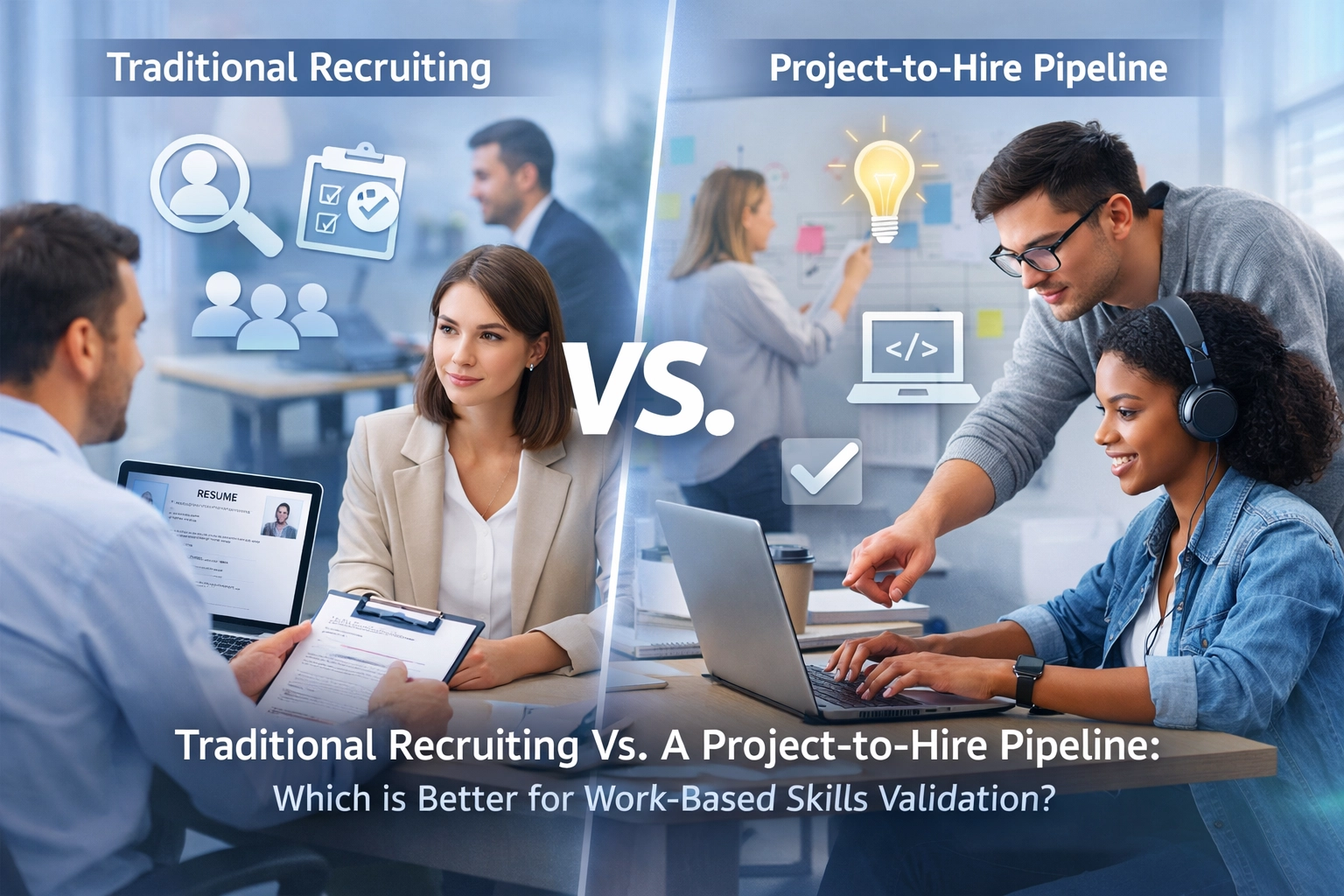
Traditional Recruiting Vs. A Project-to-Hire Pipeline: Which is Better for Work-Based Skills Validation?
When it comes to building a technical team, the core challenge isn’t just finding people, it’s validating that they can actually do the work. Traditional recruiting often relies on “proxies” for competence, such as a degree from a prestigious university or a specific job title at a well-known company. However, as the pace of technological change accelerates, these proxies are becoming less reliable. For organizations seeking true work-based skills validation, a Project-to-Hire Pipeline, specifically one built on a supervised residency model, is significantly more effective than traditional recruiting methods.
At TalentSplit, we believe that the best way to prove a candidate’s value is through a “Try Before You Hire” approach. This model allows organizations to solve immediate workload needs through staff augmentation while simultaneously evaluating talent in a real-world environment.
The Limitations of Traditional Recruiting
Traditional recruiting is essentially a high-stakes guessing game. You post a job description, scan hundreds of resumes, and conduct a few hours of interviews. In this model, you are evaluating a candidate’s ability to interview, not their ability to perform.
1. The Proxy Problem
In traditional hiring, recruiters look for credentials. While a certification or a degree is impressive, it doesn’t guarantee that a candidate can navigate a complex codebase or handle a real-time cybersecurity threat. You are betting on their past rather than validating their present capabilities.
2. High Cost of a “Bad Hire”
The financial impact of a bad hire in technical roles can be staggering. When you factor in the cost of recruitment, onboarding, and the eventual severance or loss of productivity, a single mistake can cost an organization tens of thousands of dollars.
3. Culture Fit vs. Work Fit
Traditional interviews are great for assessing if you’d like to have a coffee with someone (culture fit), but they are notoriously poor at determining if that person can meet deadlines or collaborate effectively under pressure (work fit).

Why Project-to-Hire is the Future of Talent Acquisition
A Project-to-Hire pipeline flips the script. Instead of hiring based on a promise, you hire based on proof. This model functions as an extended working audition where the candidate is integrated into your workflow through a specific project or a staff augmentation arrangement.
Immediate Productivity with Staff Augmentation
In the TalentSplit model, our talent doesn’t just sit on the sidelines. They provide high-quality technical services from day one. Whether it’s IT support, software development, or cyber insurance readiness, our contributors are actively closing tickets and shipping code.
Real-World Skills Validation
When a candidate works on a project for three to six months, you see everything:
- How they handle feedback.
- Their ability to learn new stacks quickly.
- Their communication style during a sprint.
- Their technical troubleshooting skills.
This is the ultimate form of work-based skills validation. By the time you extend a full-time offer, there is zero doubt about their ability to perform.
The TalentSplit Residency Model: A Supervised Approach
What makes TalentSplit unique is our Residency Model. We don’t just send you a junior developer and hope for the best. Our talent consists of highly motivated individuals, including senior-guided high schoolers and career transitioners, who are supervised by industry veterans.
The Power of Supervision
Every project delivered by TalentSplit talent is overseen by a senior mentor. This ensures that the technical services provided are of professional grade while allowing the “resident” to gain real-world experience. For the organization, this means you get senior-level quality at a fraction of the cost, with a built-in pipeline of vetted talent.
The Human Element: High Schoolers and Career Transitioners
We believe that talent is universal, but opportunity is not. Our residency model taps into overlooked talent pools:
- Senior-Guided High Schoolers: These digital natives are often more tech-savvy than the current workforce but lack the “professional polish.” Our supervision provides that bridge.
- Career Transitioners: Individuals moving from fields like education or retail into tech bring a wealth of soft skills and a hunger to prove themselves.
By combining these groups with senior guidance, we create a high-output environment that benefits both the organization and the individual.

The Innovation is Love™ Framework
At TalentSplit, we don’t just look at code and configurations; we look at the people behind them. Our proprietary Innovation is Love™ framework is at the heart of everything we do.
This framework is built on the belief that technical development should be human-centric. When we supervise our talent, we aren’t just checking their work for bugs; we are investing in their growth. This “love” for the craft and the person leads to higher quality outcomes for our clients. It transforms a standard business service into a collaborative partnership.
When organizations adopt this mindset, they find that their retention rates improve. Candidates who are brought in through a project-to-hire pipeline feel more invested in the company’s mission because they have already been part of the team.
Traditional Recruiting vs. Project-to-Hire: A Side-by-Side Comparison
Feature Traditional Recruiting Project-to-Hire (TalentSplit) Validation Method Resumes and Interviews Proof of Work and Residency Onboarding Risk High (Hire then see) Low (Try before you hire) Immediate Value None (Learning period) High (Supervised staff augmentation) Talent Pool Experienced / Credentialed High-potential / Supervised Cost Basis Recruitment Fees Project/Service Delivery Reliability Variable High (Senior-guided quality)
Scaling Your Technical Team with Confidence
Organizations often struggle with “lumpy” workloads, periods where they need extra hands but aren’t ready to commit to a permanent headcount. Our residency model is the perfect solution for this. You can scale your team up to handle a specific initiative, use that time to validate the skills of the residents, and then convert the top performers to full-time employees.
This approach is particularly effective for cybersecurity assessments and long-term IT maintenance. Instead of hiring a consultant who leaves after the project is done, you are building a relationship with a potential future employee.

Frequently Asked Questions (FAQ)
What is “Work-Based Skills Validation”?
It is the process of evaluating a candidate’s abilities through actual job tasks rather than theoretical tests or interviews. It provides a more accurate picture of how a candidate will perform in a specific role.
How does “Try Before You Hire” work?
Under this model, a candidate works for your company as a supervised contractor or resident for a set period. At the end of the term, you have the option to hire them full-time, knowing exactly what they bring to the table.
Are high schoolers really capable of technical work?
Yes, when they are part of a supervised residency. Our senior guides ensure that all output meets professional standards. These residents often bring fresh perspectives and a high degree of adaptability to technical projects.
What technical services does TalentSplit provide?
We offer a wide range of services including software development, IT staff augmentation, and cyber insurance readiness. All services are delivered via our supervised residency model.
Final Thoughts: The Shift Toward Practicality
The era of hiring based on a “good feeling” in an interview is coming to an end. Organizations that want to stay competitive need a more rigorous, practical way to validate skills. By choosing a Project-to-Hire pipeline through TalentSplit, you aren’t just filling a seat: you are building a resilient, proven workforce.
Whether you are looking to scale your technical team or looking for a way to give high-potential talent a chance to shine, the residency model offers a path that is more efficient, less risky, and more human.
If you’re ready to see how our supervised talent can transform your technical operations, contact us today or explore our pricing packages. Let’s stop guessing and start validating.
-
The Human Element Missing From Your Tech Services (And How Residency Models Fix It)
Your organization automated everything it could. Ticketing systems, chatbots, standardized workflows: all designed to scale technical services without scaling headcount. But somewhere along the way, something critical got lost: the human element that actually solves complex problems.
PwC’s customer experience research highlights that consumers place a high value on human connection, favoring speed, convenience, knowledgeable help, and friendly service; areas where human interaction often plays a central role. That preference isn’t nostalgia: it’s recognition that technology alone can’t provide the contextual understanding, empathy, and creative problem-solving that complex technical work demands.
The question isn’t whether to use technology or people. It’s how to deliver high-quality technical services that blend both: without the risk, cost, or long hiring cycles of traditional staffing.
Why Pure Automation Falls Short in Technical Services
Automation excels at repetitive tasks. It fails at everything else.
When your security posture needs assessment, your infrastructure requires custom configuration, or your compliance documentation demands interpretation of nuanced requirements, automated tools hit a wall. They can’t:
- Understand context beyond their programmed parameters
- Apply judgment to ambiguous situations
- Communicate effectively when stakeholders need clarity
- Adapt approaches when the standard playbook doesn’t fit

A chatbot can reset passwords. It can’t architect a zero-trust network or explain why your current authentication approach creates risk. That requires human intelligence, guided by experience.
But here’s the catch: hiring experienced professionals for every technical need creates its own problems.
The Traditional Hiring Dilemma
Organizations face a painful choice when they need technical expertise:
Option A: Hire full-time staff and commit to long-term salaries for potentially fluctuating workload needs. You’re locked in, whether the work continues or not.
Option B: Contract with agencies and pay premium rates for talent you can’t vet beforehand. You’re gambling on quality with every engagement.
Option C: Use platforms and sift through hundreds of profiles, conduct interviews, and still have no proof the person can actually deliver what you need.
None of these options solve the fundamental problem: you can’t validate technical capability until after you’ve made the commitment.
Traditional hiring asks you to bet on potential. Residency models let you see proven performance first.
How Residency Models Restore the Human Element
A residency model flips the traditional hiring equation. Instead of recruiting individuals and hoping they can deliver, organizations access supervised project delivery where the human element is embedded in the structure itself.
Here’s how it works:
Senior technical professionals guide developing talent through real client work. The residents: whether they’re high schoolers with fresh certifications or career transitioners who’ve completed training programs: deliver the actual services under direct supervision.
This creates something neither automation nor traditional hiring can match: human intelligence and care at every layer, with enterprise-grade oversight built in.

The senior expert ensures quality, mentors through complexity, and catches errors before they reach you. The resident brings energy, attention to detail, and genuine investment in proving their capability. Together, they deliver technical services with the human touch automation can’t replicate: and the reliability individual contractors can’t guarantee.
Work-Based Skills Validation: Proof Before Commitment
The Innovation is Love™ framework recognizes a simple truth: the best way to prove someone can do the work is to let them do the work.
Work-based skills validation means you’re not evaluating resumes, certifications, or interview performance. You’re evaluating actual deliverables from real projects:
- Security assessments completed for your environment
- Documentation created for your systems
- Configurations implemented in your infrastructure
- Support provided to your users
This is proof-of-work hiring in action. You see the results before you make any employment decision.
For organizations, this eliminates hiring risk. You’re not guessing whether someone can handle your technical needs: you’ve already watched them do it.
For talent, this closes the “experience required” loop. They’re not trying to convince someone they can do work they’ve never done. They’re pointing to work they’ve already delivered successfully, with verification from senior professionals who supervised every step.
The Try Before You Hire Pipeline
The most valuable aspect of supervised project delivery isn’t just the immediate technical results. It’s the project-to-hire pipeline it creates.
When a resident consistently delivers quality work on your projects, you have the option to hire them directly. You already know:
- How they communicate under pressure
- How quickly they learn your systems
- How they handle feedback and complexity
- Whether they fit your organizational culture

There’s no interview theater. No reference checks from people who might oversell or undersell capability. No probationary period where you’re still unsure if this was the right choice.
You’ve already worked together. The decision to hire becomes obvious, not risky.
Organizations benefit from a vetted technical workforce they’ve essentially auditioned through real work. Trained individuals benefit from supervised experience that proves their skills and creates direct paths to employment.
Who This Serves (And Why It Works)
For Organizations Seeking Reliable Technical Results
If your organization needs cybersecurity assessments, IT infrastructure support, compliance documentation, or other technical services: but doesn’t need (or want) to hire full-time staff: supervised project delivery provides:
- Verified cybersecurity talent and technical professionals you can trust
- Reduced hiring risk because you see performance before making any commitment
- Flexible capacity that scales with your actual workload needs
- Quality oversight from senior experts who own the final deliverables
You get the human element that automation can’t provide, without the risk that traditional hiring creates.
For Trained Individuals Seeking Real-World Experience
If you’ve completed technical training: whether you’re a high school graduate with certifications or a career transitioner who’s invested in new skills: but can’t break into the field because “every job requires experience,” supervised projects provide:
- Proof of work you can show future employers
- Senior guidance that accelerates your learning and prevents costly mistakes
- Direct paths to employment when you prove your capability through real deliverables
- Paid experience that validates your training in actual client environments
You’re not asking someone to take a chance on you. You’re showing them what you’ve already accomplished.
Innovation is Love™: The Framework Behind the Model
The Innovation is Love™ framework isn’t a slogan. It’s the operational philosophy that makes supervised project delivery work.
Innovation means we’ve built a structure that solves real problems: reducing hiring risk for organizations while creating experience pathways for talent: not by compromising on quality, but by amplifying it through human collaboration.
Love means we care about outcomes for everyone involved:
- Organizations receive reliable technical services they can trust
- Residents gain verified experience that changes their career trajectory
- Senior professionals share their expertise in ways that scale impact beyond individual contributor work
This isn’t about replacing experienced professionals with cheaper labor. It’s about creating a sustainable model where human expertise multiplies through guided supervision, benefiting clients and developing talent simultaneously.
What This Looks Like in Practice
When you engage supervised project delivery services, here’s what happens:
- You define the technical work you need: security assessment, infrastructure audit, compliance documentation, IT support, etc.
- A senior professional scopes the project and assigns appropriate residents based on their developing skills and the work requirements.
- Residents perform the actual technical work under continuous oversight, with the senior expert reviewing deliverables at every stage.
- You receive completed work that meets enterprise standards, backed by the senior professional’s verification.
- If a resident consistently performs well, you have the option to hire them directly: with full confidence in their capability because you’ve already seen their work.
The human element is present at every step. The quality control is built into the structure. The risk is minimized because you’re evaluating actual performance, not predicted potential.
Closing the Loop
Technology will continue advancing. Automation will handle more routine tasks. But the human element in technical services: the judgment, empathy, contextual understanding, and creative problem-solving that complex work demands: isn’t going anywhere.
The question is how to access that human element reliably, affordably, and without the hiring risks that have made staffing technical roles increasingly difficult.
Supervised project delivery through residency models provides the answer. You get verified technical talent delivering quality work under expert guidance, with the option to hire proven performers when it makes sense.
Organizations solve their changing workload needs. Trained individuals prove their skills through real work. And the technical services you receive maintain the human intelligence that automation can never replicate.
That’s not just good business: it’s Innovation is Love™ in action.
Ready to experience supervised technical services with the Try Before You Hire benefit? Learn more about how TalentSplit connects organizations with verified talent through our residency model.
-

Stuck After Training? How to Use Supervised Projects to Land Your First Tech Role
You finished the bootcamp. You passed the certification. You watched every tutorial. Now what?
If you’re staring at job postings demanding “3-5 years experience” while you’re sitting on zero, you’ve hit the most frustrating wall in tech: the experience gap. Training gets you ready: but it doesn’t get you hired. That’s where supervised project delivery comes in. It’s the bridge between “I know how to do this” and “I’ve proven I can do this.” Here’s how to use real-world, supervised projects to close that loop and land your first role.
The Real Problem: Training Doesn’t Equal Employment
Let’s be honest. Finishing a cybersecurity course or an IT certification feels like a win: and it is. But employers aren’t looking at your certificate. They’re asking: “Can you actually deliver results under real-world conditions?”

Your resume says you know Python. Great. But have you debugged a live system at 2 a.m.? Your LinkedIn says “AWS Certified.” Awesome. But have you deployed infrastructure for an actual client with actual deadlines?
This isn’t a knock on your training. It’s a structural problem in the hiring process. Organizations need proof, not potential. And without supervised, real-world experience, you’re stuck in a loop: can’t get a job without experience, can’t get experience without a job.
What Supervised Project Delivery Actually Means
Supervised project delivery isn’t an internship. It’s not volunteer work. It’s real client work with expert oversight: where you’re executing live IT, cybersecurity, or technical projects under the guidance of someone who’s already been there.
Think of it this way:
- You’re not just practicing on fake datasets or toy apps
- You’re solving actual business problems for actual organizations
- You’re being supervised by professionals who review your work, catch mistakes before they ship, and coach you through the nuances
- The project gets delivered successfully, and you get documented proof that you contributed
This is work-based skills validation. You’re not asking an employer to take a leap of faith. You’re showing up with proof.
How Proof-of-Work Hiring Changes the Game
Traditional hiring goes like this: submit resume → interview → technical test → maybe get hired. Proof-of-work hiring flips it: do the work first, prove you can deliver, then get the offer.
Here’s why this matters for you:
Quality beats quantity. A 2024 survey found that 80% of hiring managers prioritize project quality over the number of projects on your resume. One excellent, supervised project where you shipped real results? That’s more valuable than ten half-finished GitHub repos.
Results speak louder than keywords. You can list “network security” on your resume all day. Or you can point to a documented project where you implemented security protocols for a real organization: and quantify the impact. “Reduced vulnerability exposure by 40%” is infinitely more compelling than “familiar with cybersecurity best practices.”
Side projects aren’t enough anymore. Building a to-do app or cloning an e-commerce site is fine for learning. But employers see thousands of those. They need proof that you can work in a professional environment, meet deadlines, collaborate under pressure, and deliver value.
That’s what supervised projects give you: real proof, not practice runs.

The Project-to-Hire Pipeline Explained
This is where things get interesting. A project-to-hire pipeline isn’t just about getting one project done. It’s about creating a direct path from “supervised contributor” to “full-time hire.”
Here’s how it works:
1. Organizations Submit Real Project Needs
A company has a legitimate IT or cybersecurity challenge: migrating infrastructure, building automation, securing endpoints, whatever. They need it done, but they’re not ready to hire blindly.
2. You Work on That Project Under Supervision
You’re matched to projects that align with your training. You’re not thrown in alone: there’s oversight, feedback, and quality control. You execute. You learn. You deliver.
3. Your Work Gets Documented as Proof
Every contribution is tracked. Your role, your deliverables, your impact. This isn’t a vague “I helped out on a team project.” It’s specific, verifiable proof-of-work.
4. The Organization Sees You in Action
They don’t have to guess if you’re competent. They’ve watched you perform under real conditions. If you delivered, they already know you can do the job.
5. Successful Contributors Transition to Full Employment
The best part? Organizations that are happy with your work can hire you directly: often without the traditional interview gauntlet. You’ve already proven yourself. The risk is gone.
This is the loop closing. Training → Supervised Project → Proof-of-Work → Employment.

How to Get Started with Supervised Projects
If you’re ready to move from “trained” to “hired,” here’s the practical playbook:
Match Your Training to Real Needs
Look for opportunities where your existing skills: even if they’re fresh: align with what organizations actually need. If you finished a cybersecurity bootcamp, find supervised projects focused on vulnerability assessment or compliance. If you’re IT-certified, look for infrastructure or cloud migration work.
Prioritize Supervision and Feedback
Don’t just chase any project. Make sure there’s real oversight. You need someone who can review your work, correct your mistakes, and teach you the gaps between theory and practice. Supervised delivery protects both you and the organization: and it’s what makes the proof credible.
Document Everything
Keep a record of what you built, what problems you solved, and the measurable outcomes. Did your automation save time? Did your security implementation reduce risk? Quantify it. Those numbers are what hiring managers care about.
Treat It Like a Job, Not a Side Project
Show up on time. Communicate clearly. Ask for feedback. Meet deadlines. The organizations you’re working with are taking a chance on you: prove you’re worth it. That professionalism is part of your proof-of-work too.

What Actually Matters in Your Proof-of-Work
Not all project experience is created equal. Here’s what hiring managers and organizations are actually looking for when they evaluate your supervised work:
Real-world complexity. Did you work on something that had actual constraints: deadlines, dependencies, stakeholders? Or was it a controlled sandbox?
Professional collaboration. Did you work with others? Take feedback? Navigate tradeoffs? Employers want to see that you can function in a team, not just code in isolation.
Deployed results. Did your work ship? Did it create measurable value? A half-finished project that never went live doesn’t count.
Problem-solving under pressure. Did you encounter obstacles? How did you adapt? The messiness of real projects is what separates “trained” from “ready.”
When you can point to supervised projects that hit these marks, you’re no longer competing with hundreds of other candidates who “completed a bootcamp.” You’re in a different category entirely.
Frequently Asked Questions
How is this different from an internship?
Supervised projects are focused on delivery, not just learning. You’re contributing to real client work that gets used, not just observing or doing busywork. And the goal is explicit: prove you can do the job so you can get hired.Do I get paid for supervised project work?
It depends on the model. Some supervised project opportunities are paid, some offer a stipend, and some operate on a performance-to-hire basis. The key is that successful contributors transition into full employment: so the real compensation comes from landing the role.What if I make mistakes during a supervised project?
That’s exactly why it’s supervised. Mistakes are expected: you’re still learning. The oversight ensures errors get caught and corrected before they cause problems. That’s the whole point: you get to fail safely while still delivering quality work.How long does it take to transition from supervised projects to full employment?
It varies. Some contributors land offers after one successful project. Others build proof across multiple engagements. The more you deliver, the stronger your proof-of-work becomes.
The gap between training and employment isn’t going away. But supervised project delivery: backed by proof-of-work hiring and a real project-to-hire pipeline: gives you a way through.
You don’t need to fake experience. You need to earn it under real conditions, with real stakes, and real supervision. That’s how you stop being “stuck after training” and start being employed.
Ready to close the loop? Learn more about how TalentSplit connects trained individuals with supervised project opportunities.
-

Try Before You Hire: 7 Ways Supervised Tech Services Are Revolutionizing Small Business Hiring
Small businesses face a familiar paradox. You need technical expertise to grow, but you can’t afford to make expensive hiring mistakes. Traditional staffing approaches force you to commit before you really know if someone fits your team and culture. Enter the supervised tech services model: a game-changing approach that lets you evaluate talent while they deliver real value to your business.
What Makes Supervised Tech Services Different
The supervised residency model combines developing talent with experienced oversight. Senior professionals coach high school students and career transitioners through real-world projects for actual clients. This creates a unique ecosystem where small businesses get affordable technical services while simultaneously evaluating potential future hires.
Think of it as an extended working interview. Instead of making hiring decisions based on a few hours of conversation and a polished resume, you observe how candidates perform on actual projects over weeks or months. You see their work ethic, problem-solving abilities, and cultural fit in action: not just on paper.

1. Risk-Free Talent Vetting
Traditional hiring involves significant risk.HR research frequently estimates the cost of a bad hire at roughly 30% of an employee’s first-year salary, with some studies placing it much higher. For small businesses with tight margins, even one bad hire can have a disproportionate and damaging financial impact.
The supervised services model eliminates this risk entirely. You’re not committing to employment. You’re purchasing services with the added benefit of observing talent in their natural habitat. If a developing worker excels on your project and demonstrates the qualities you value, you have the option to make an offer. If not, you’ve still received quality work at an affordable rate: no costly severance, no awkward conversations, no wasted recruitment expenses.
This approach aligns with the Innovation is Love™ framework: prioritizing genuine human connection and mutual benefit over transactional relationships. Both the business and the developing professional have the opportunity to explore fit without pressure.
2. Access to Affordable Technical Expertise
Small businesses often need technical services but can’t justify full-time specialists. Cybersecurity assessments, 3D printing prototypes, digital marketing campaigns: these capabilities typically require either expensive agencies or salaried employees.
The supervised model changes the economics entirely. Developing talent performs the work under expert guidance, delivering professional-grade results at a fraction of traditional costs. The senior supervisor ensures quality standards are met while providing learning opportunities for emerging professionals.
Consider a small manufacturer needing occasional 3D printing services. Hiring a full-time specialist doesn’t make sense, but outsourcing to agencies gets expensive quickly. With supervised services, you get professional-quality prototypes at accessible rates, with the added advantage of building a relationship with talent who might eventually join your team.

3. Supervised Quality Assurance Built In
One concern businesses express about working with developing talent is quality control. This is where the supervision component becomes crucial.
Every project includes oversight from experienced professionals who have deep expertise in their respective fields. These senior workers serve as both coaches and quality gatekeepers. They review work, provide feedback, and ensure deliverables meet professional standards before reaching your desk.
This creates a win-win-win scenario:
- Businesses receive quality work with built-in review processes
- Developing talent gains real-world experience with expert mentorship
- Senior professionals contribute their expertise while developing the next generation
The supervision layer means you’re never gambling on unproven talent working independently. Every deliverable goes through experienced eyes before you see it.
4. Building Your Future Workforce
The most strategic benefit of this model is the pipeline it creates for future hiring. You’re essentially running an extended evaluation period that reveals far more than any traditional interview process could.
Over the course of one or multiple projects, you observe:
- Work quality and attention to detail
- Communication style and responsiveness
- Problem-solving approaches
- Ability to receive and implement feedback
- Cultural alignment with your team values
- Growth trajectory and learning speed
These insights are invaluable. When you eventually need to hire, you’re not starting from scratch with strangers. You have a pool of professionals you’ve already worked with: people whose capabilities and character you’ve witnessed firsthand.
5. All US-Based Talent
In an increasingly globalized economy, many businesses struggle to find affordable services while maintaining certain preferences around location and time zones. The supervised tech services model emphasizes US-based talent exclusively.
This matters for several reasons:
- Time zone alignment makes collaboration seamless
- Cultural and communication context reduces misunderstandings
- Support for local communities through talent development
- Simplified logistics for potential future employment
For small businesses considering eventual hiring, working with US-based talent eliminates concerns about visas, relocation, or remote work arrangements across vast time differences. The talent you evaluate through projects can transition smoothly to your team if mutual interest develops.
6. Pay-When-Satisfied Guarantee
Perhaps the most revolutionary aspect of this model is the financial structure. Traditional service providers and employment arrangements lock you into payment regardless of satisfaction. The supervised services approach flips this script.
You pay only when you’re satisfied with the work delivered. This isn’t a “money-back guarantee” with fine print: it’s a fundamental shift in how business services operate. If the work doesn’t meet your standards, you don’t pay for that deliverable.
This guarantee demonstrates confidence in the quality control processes and the supervision model itself. It also creates the right incentives: everyone involved is motivated to ensure your satisfaction because compensation depends on it.
For small businesses operating on thin margins, this protection is invaluable. You can experiment with new technical capabilities without fear of wasting precious capital on subpar work.

7. Comprehensive Technical Services Portfolio
The supervised model isn’t limited to one or two service areas. Small businesses can access a full spectrum of technical capabilities:
- Cybersecurity services: Vulnerability assessments, security audits, policy development
- 3D printing and prototyping: Product design, rapid prototyping, manufacturing support
- Digital marketing: Content creation, social media management, campaign development
- Web development: Site creation, maintenance, optimization
- Data analysis: Business intelligence, reporting, insights generation
This comprehensive approach means you can address multiple technical needs through a single relationship model. As you work with different developing professionals across various projects, you’re simultaneously evaluating talent across different skill sets.
For organizations needing more complex or specialized services, the model scales appropriately while maintaining the supervised structure and quality assurance.
The Bigger Picture: Innovation is Love™ in Action
The supervised tech services model embodies a philosophy that business innovation should serve human flourishing. Innovation is Love™ represents the belief that technological advancement and business models should create opportunity and dignity for everyone involved.
By creating pathways for high school students and career transitioners to gain real experience under expert supervision, while simultaneously helping small businesses access affordable technical services, this approach rejects zero-sum thinking. Everyone benefits:
- Small businesses get quality services, reduced hiring risk, and talent pipelines
- Developing professionals gain paid experience, mentorship, and employment opportunities
- Senior experts contribute their knowledge while earning income
- Local communities benefit from workforce development and opportunity creation
This approach to community impact demonstrates that business models can be both economically viable and socially beneficial.
Making the Shift
For small business owners accustomed to traditional hiring and service provider relationships, the supervised tech services model requires a mindset shift. Instead of viewing talent development and business services as separate categories, this approach integrates them into a unified ecosystem.
The “Try Before You Hire” concept isn’t just about reducing risk: it’s about building genuine relationships over time. You’re not evaluating resumes and hoping for the best. You’re working alongside developing professionals, observing their growth, and making informed decisions about who might eventually join your team.
Getting started means identifying technical needs your business faces and exploring how supervised services might address them. Whether you need cybersecurity support, marketing help, or specialized technical capabilities, the model provides a low-risk entry point.
The revolution in small business hiring isn’t about better interview questions or more sophisticated screening tools. It’s about fundamentally rethinking the relationship between service delivery and talent evaluation: creating systems where everyone wins and innovation truly serves love.
-

Crossing the competency canyon to unlock amazing innovation

I had the privilege of representing CISOSHARE, CyberForward Academy, and TalentSplit among policy makers, practitioners, and innovators at Mar-a-Lago a little over a week ago. The experience highlighted the exceptional work underway by so many and underscored the growing importance of crossing the competency canyon to reach it.
The amazing work being done
So many amazing leaders and their organizations or agencies are developing game-changing innovation that will power America forward. However, it also reinforced why I am passionate about our teams’ efforts in building companies that support and secure this innovation, as well as building the next generation of required talent to develop and then operate it.
Crossing the competency canyon was a key theme
Across these discussions, one theme was clear. The United States needs significantly more technical talent to meet our innovation priorities. Also, as we continue to identify even greater objectives, we need the ability to develop that talent even faster and at scale. I have been calling this crossing the competency canyon. It is the means in which we can best transition technical learners into skilled innovation workers that are productive.
My background in sports has shown me that execution in any of these complex endeavors requires skilled resources. Resources who understand and are proficient in preparation, teamwork, technical capability, continued and consistent practice, and an ability to execute among other things. With my time as a credentialed teacher, our teams work in non-profits supporting workforce development, and my background in business I have learned so many lessons. It is these experiences I am using to lead our teams and bring these ideas together into a cohesive framework.
Moving forward to cross the competency canyon.
There are four capabilities I believe we must build in the United States to help Americans cross the competency canyon. Further, we must apply them consistently if we want to remain competitive in innovation. These capabilities cannot sit within a single domain such as education or government alone. They require a team-based model built on standards that drives alignment, speed, and scale across the entire United States. This is my mission and of those I am leading.
These are the same capabilities we focus on across our ecosystem of companies to support innovation and cross the competency canyon. Since meaningful innovation is always a team effort, I often use soccer as a straightforward way to describe these capabilities.
1. A uniform way to measure technical proficiency
In soccer, this is structured player performance measurement and keeping score that traverses a player’s career. In technology, we need transparent and repeatable assessments that show the learner where they are over years, not through just a class. We also need to give them insight so they can plan where they need to go along their learning journey. Finally, we need to provide individualized support and guidance along the way as they execute the plan. This guidance and direction is a key component to crossing the competency canyon.
2. Common innovation standards across schools, businesses, government, and communities
In soccer, this is a consistent set of rules and field dimensions regardless of where you play or at what level. Whether for a pick-up game, a local youth club or the national team. In technology, shared standards allow alignment across classes, training programs, internships, jobs, industries and in community-based organizations. This helps so talent can progress with consistency and without starting over each time.
3. Accessible innovation training and development centers built on shared standards
This his is the network of consistent sports parks and stadiums in soccer that make training available to anyone. In technology, this means creating environments where people can learn, practice, and innovate with real tools and in realistic situations. Just think if we had as many IT support training centers or makers spaces that are as accessible as we do sports parks. Making this a reality is my purpose and another key component to crossing the competency canyon.
4. Scalable development techniques such as video and recorded analysis
In soccer, youth players use platforms like Trace or Hudl to learn and experience the game. Further, all of us can learn through watching professional games on networks like ESPN. In technology, realistic or even more aligned AI recorded work, simulations, and structured feedback loops can accelerate learning and scale. Innovation is still a human process, and it can be helpful to see us all being human as we learn and produce while we do it. Seeing innovation first hand is an amazing way to scale talent in crossing the competency canyon.
Conclusion
The United States needs these four elements working together and available nationwide as critical success factors in crossing the competency canyon. We have been building models and programs that support this approach across CISOSHARE, CyberForward Academy, and TalentSplit for the last. More on these efforts will be shared soon.
About the author
Mike Gentile is the founder and CEO of Talentsplit, CISOSHARE, and CyberForward Academy. His work centers on maintaining United States leadership by securing innovation and developing the talent required to sustain it.