
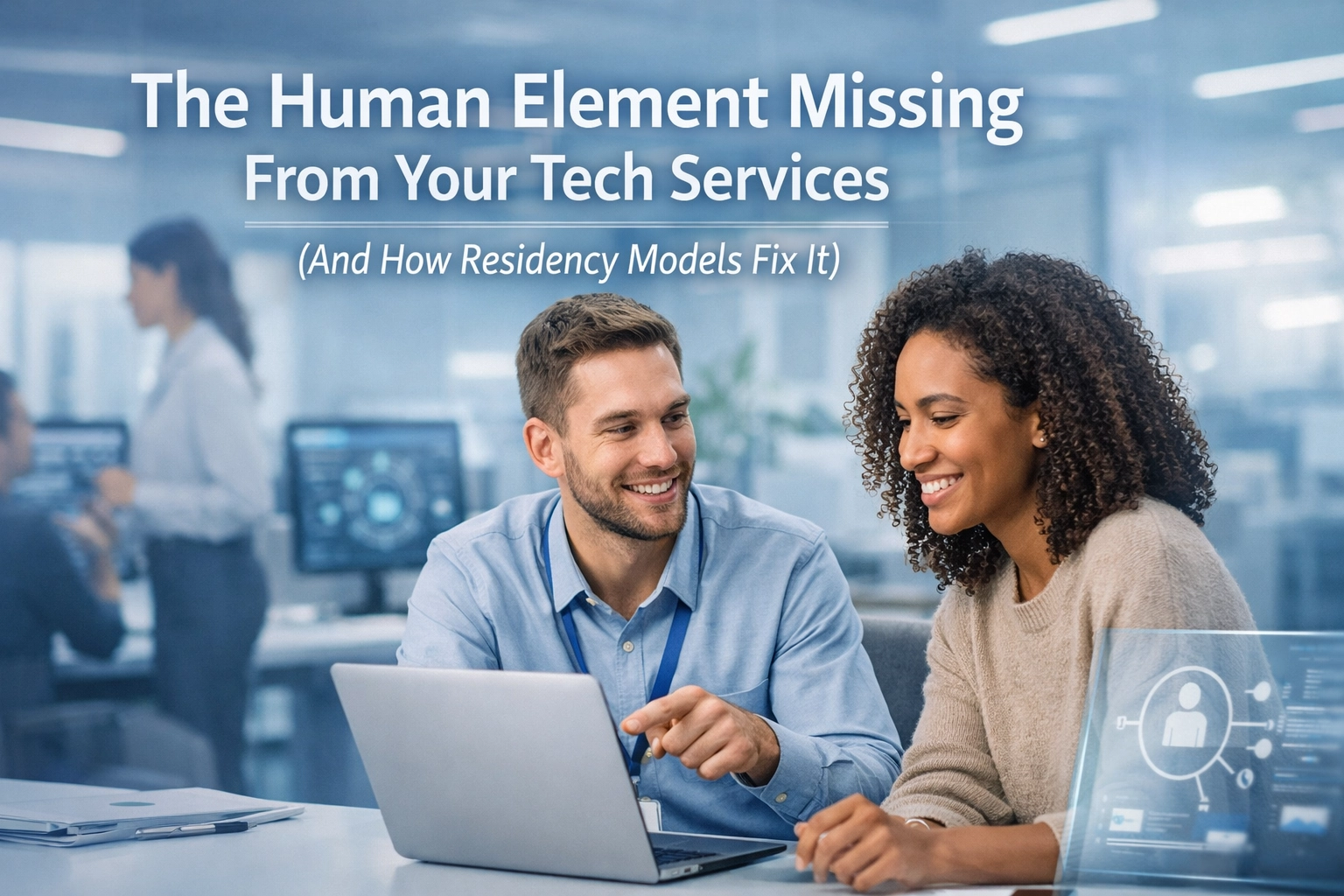
Your organization automated everything it could. Ticketing systems, chatbots, standardized workflows: all designed to scale technical services without scaling headcount. But somewhere along the way, something critical got lost: the human element that actually solves complex problems.
PwC’s customer experience research highlights that consumers place a high value on human connection, favoring speed, convenience, knowledgeable help, and friendly service; areas where human interaction often plays a central role. That preference isn’t nostalgia: it’s recognition that technology alone can’t provide the contextual understanding, empathy, and creative problem-solving that complex technical work demands.
The question isn’t whether to use technology or people. It’s how to deliver high-quality technical services that blend both: without the risk, cost, or long hiring cycles of traditional staffing.
Why Pure Automation Falls Short in Technical Services
Automation excels at repetitive tasks. It fails at everything else.
When your security posture needs assessment, your infrastructure requires custom configuration, or your compliance documentation demands interpretation of nuanced requirements, automated tools hit a wall. They can’t:
- Understand context beyond their programmed parameters
- Apply judgment to ambiguous situations
- Communicate effectively when stakeholders need clarity
- Adapt approaches when the standard playbook doesn’t fit

A chatbot can reset passwords. It can’t architect a zero-trust network or explain why your current authentication approach creates risk. That requires human intelligence, guided by experience.
But here’s the catch: hiring experienced professionals for every technical need creates its own problems.
The Traditional Hiring Dilemma
Organizations face a painful choice when they need technical expertise:
Option A: Hire full-time staff and commit to long-term salaries for potentially fluctuating workload needs. You’re locked in, whether the work continues or not.
Option B: Contract with agencies and pay premium rates for talent you can’t vet beforehand. You’re gambling on quality with every engagement.
Option C: Use platforms and sift through hundreds of profiles, conduct interviews, and still have no proof the person can actually deliver what you need.
None of these options solve the fundamental problem: you can’t validate technical capability until after you’ve made the commitment.
Traditional hiring asks you to bet on potential. Residency models let you see proven performance first.
How Residency Models Restore the Human Element
A residency model flips the traditional hiring equation. Instead of recruiting individuals and hoping they can deliver, organizations access supervised project delivery where the human element is embedded in the structure itself.
Here’s how it works:
Senior technical professionals guide developing talent through real client work. The residents: whether they’re high schoolers with fresh certifications or career transitioners who’ve completed training programs: deliver the actual services under direct supervision.
This creates something neither automation nor traditional hiring can match: human intelligence and care at every layer, with enterprise-grade oversight built in.

The senior expert ensures quality, mentors through complexity, and catches errors before they reach you. The resident brings energy, attention to detail, and genuine investment in proving their capability. Together, they deliver technical services with the human touch automation can’t replicate: and the reliability individual contractors can’t guarantee.
Work-Based Skills Validation: Proof Before Commitment
The Innovation is Love™ framework recognizes a simple truth: the best way to prove someone can do the work is to let them do the work.
Work-based skills validation means you’re not evaluating resumes, certifications, or interview performance. You’re evaluating actual deliverables from real projects:
- Security assessments completed for your environment
- Documentation created for your systems
- Configurations implemented in your infrastructure
- Support provided to your users
This is proof-of-work hiring in action. You see the results before you make any employment decision.
For organizations, this eliminates hiring risk. You’re not guessing whether someone can handle your technical needs: you’ve already watched them do it.
For talent, this closes the “experience required” loop. They’re not trying to convince someone they can do work they’ve never done. They’re pointing to work they’ve already delivered successfully, with verification from senior professionals who supervised every step.
The Try Before You Hire Pipeline
The most valuable aspect of supervised project delivery isn’t just the immediate technical results. It’s the project-to-hire pipeline it creates.
When a resident consistently delivers quality work on your projects, you have the option to hire them directly. You already know:
- How they communicate under pressure
- How quickly they learn your systems
- How they handle feedback and complexity
- Whether they fit your organizational culture

There’s no interview theater. No reference checks from people who might oversell or undersell capability. No probationary period where you’re still unsure if this was the right choice.
You’ve already worked together. The decision to hire becomes obvious, not risky.
Organizations benefit from a vetted technical workforce they’ve essentially auditioned through real work. Trained individuals benefit from supervised experience that proves their skills and creates direct paths to employment.
Who This Serves (And Why It Works)
For Organizations Seeking Reliable Technical Results
If your organization needs cybersecurity assessments, IT infrastructure support, compliance documentation, or other technical services: but doesn’t need (or want) to hire full-time staff: supervised project delivery provides:
- Verified cybersecurity talent and technical professionals you can trust
- Reduced hiring risk because you see performance before making any commitment
- Flexible capacity that scales with your actual workload needs
- Quality oversight from senior experts who own the final deliverables
You get the human element that automation can’t provide, without the risk that traditional hiring creates.
For Trained Individuals Seeking Real-World Experience
If you’ve completed technical training: whether you’re a high school graduate with certifications or a career transitioner who’s invested in new skills: but can’t break into the field because “every job requires experience,” supervised projects provide:
- Proof of work you can show future employers
- Senior guidance that accelerates your learning and prevents costly mistakes
- Direct paths to employment when you prove your capability through real deliverables
- Paid experience that validates your training in actual client environments
You’re not asking someone to take a chance on you. You’re showing them what you’ve already accomplished.
Innovation is Love™: The Framework Behind the Model
The Innovation is Love™ framework isn’t a slogan. It’s the operational philosophy that makes supervised project delivery work.
Innovation means we’ve built a structure that solves real problems: reducing hiring risk for organizations while creating experience pathways for talent: not by compromising on quality, but by amplifying it through human collaboration.
Love means we care about outcomes for everyone involved:
- Organizations receive reliable technical services they can trust
- Residents gain verified experience that changes their career trajectory
- Senior professionals share their expertise in ways that scale impact beyond individual contributor work
This isn’t about replacing experienced professionals with cheaper labor. It’s about creating a sustainable model where human expertise multiplies through guided supervision, benefiting clients and developing talent simultaneously.
What This Looks Like in Practice
When you engage supervised project delivery services, here’s what happens:
- You define the technical work you need: security assessment, infrastructure audit, compliance documentation, IT support, etc.
- A senior professional scopes the project and assigns appropriate residents based on their developing skills and the work requirements.
- Residents perform the actual technical work under continuous oversight, with the senior expert reviewing deliverables at every stage.
- You receive completed work that meets enterprise standards, backed by the senior professional’s verification.
- If a resident consistently performs well, you have the option to hire them directly: with full confidence in their capability because you’ve already seen their work.
The human element is present at every step. The quality control is built into the structure. The risk is minimized because you’re evaluating actual performance, not predicted potential.
Closing the Loop
Technology will continue advancing. Automation will handle more routine tasks. But the human element in technical services: the judgment, empathy, contextual understanding, and creative problem-solving that complex work demands: isn’t going anywhere.
The question is how to access that human element reliably, affordably, and without the hiring risks that have made staffing technical roles increasingly difficult.
Supervised project delivery through residency models provides the answer. You get verified technical talent delivering quality work under expert guidance, with the option to hire proven performers when it makes sense.
Organizations solve their changing workload needs. Trained individuals prove their skills through real work. And the technical services you receive maintain the human intelligence that automation can never replicate.
That’s not just good business: it’s Innovation is Love™ in action.
Ready to experience supervised technical services with the Try Before You Hire benefit? Learn more about how TalentSplit connects organizations with verified talent through our residency model.
Leave a Reply